
How to Start Planning a Destination Wedding: A Step-by-Step Guide
filed in Planning Tips & Tricks - 13 March 2026


SUMMARY
- Step 1: Lock In Your Vision Before Anything Else
- Step 2: Set a Realistic Budget
- Step 3: Choose Your Destination and Start Venue Hunting
- Step 4: Build Your Timeline
- Step 5: Assemble Your Vendor Team
- Step 6: Think Through Guest Logistics
- Step 7: Understand the Legal Side
- Do You Need a Destination Wedding Planner?
- Frequently Asked Questions
The moment you decide on a destination wedding, everything feels exciting. Then, about twenty minutes later, the questions start. Where do we even begin? Indeed, I hear this from almost every couple who reaches out to me. After years of planning destination weddings in Provence for American couples, I’ve developed a clear starting framework. The process is less overwhelming than it looks — when you approach it in the right order.
So let’s go through it, step by step.
Step 1: Lock In Your Vision Before Anything Else
Before you open a single venue website, sit down together and talk about what kind of experience you actually want. Not the flowers, not the dress — the feeling. Do you want something intimate and slow-paced, or a full multi-day celebration? Do your guests come from one country or many? How important is food, wine, architecture, landscape?
In my experience, the couples who skip this conversation spend months going in circles. They fall in love with a venue that doesn’t suit their guest count. Moreover, they choose a country that doesn’t match their aesthetic. Simply put, starting with vision saves everything else.
For many of the couples I work with, Provence answers most of these questions naturally. The landscape, the light, the food, the pace — it all points toward a certain kind of celebration. However, whatever destination calls to you, start there: with feeling, not logistics.
Step 2: Set a Realistic Budget
Understand What a Destination Wedding Actually Costs
A destination wedding almost always costs more than a local one. Travel, accommodation, international vendor fees, and logistics all add up quickly. Furthermore, many couples underestimate currency exchange, service charges, and the cost of hosting guests across multiple days.
In Provence specifically, a well-planned destination wedding for 80 to 120 guests typically starts at €120,000. For a fully produced, multi-space celebration with a specialist décor team, that number rises significantly. However, knowing your range upfront means every decision that follows — venue, catering, entertainment — stays grounded in reality.
Prioritise What Matters Most to You
Not every budget line carries equal weight. Indeed, some couples prioritise food and wine above everything else. Others care most about the setting. Decide early where your money does the most work for your vision, and protect that line item first. Then build the rest around it.
Step 3: Choose Your Destination and Start Venue Hunting
Once you have a vision and a budget, the destination choice becomes much easier. Essentially, you’re not choosing a country from a list — you’re matching a place to a feeling you’ve already identified.
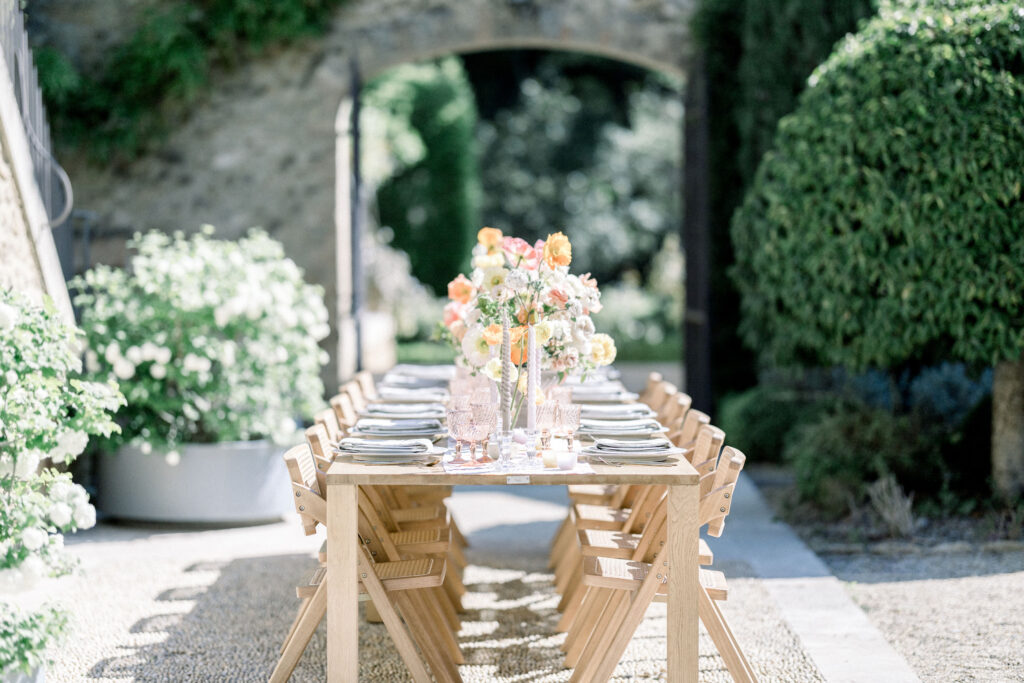
When it comes to venue hunting, resist the urge to research everything at once. Instead, shortlist three to five venues that genuinely excite you, and go deep on each one. Look at capacity, catering policy, accommodation on site, noise restrictions, and available dates. Above all, ask yourself whether the space gives you room to create something truly personal — or whether it boxes you in.
For example, in Provence, venues range from intimate bastides to grand chateaux and estate properties with multiple outdoor spaces. Each one suits a different kind of celebration. Consequently, knowing what you want from Step 1 makes the shortlist almost obvious.
Step 4: Build Your Timeline
How Far in Advance Should You Start?
For a destination wedding, 18 to 24 months of lead time is the baseline. In fact, for popular venues in Provence, some dates disappear 18 to 24 months out. Therefore, the earlier you move, the more options you have.
As a general framework, here is how I think about the timeline:
- 18–24 months out: Vision, budget, destination, venue shortlist.
- 12–18 months out: Venue secured, planner engaged, key vendors booked.
- 9–12 months out: Guest logistics, save the dates, accommodation blocks.
- 6 months out: Design decisions, menu tasting, detailed run-of-show.
- 3 months out: Final confirmations, guest RSVPs, logistics locked.
Consequently, the couples who struggle most are those who start at 12 months and try to compress everything. Indeed, time is one of the most valuable resources in destination wedding planning.
Step 5: Assemble Your Vendor Team
This is where destination weddings diverge most sharply from local ones. Your vendor team works in a country you don’t live in, in a language you may not speak. Therefore, the relationships between vendors matter enormously. A florist who has never worked with your caterer at your venue creates friction. Similarly, a photographer unfamiliar with the light at golden hour on that specific property misses the shot.
The right vendor team for a destination wedding is not a collection of individuals — it’s a network that already knows how to work together. Indeed, this is one of the most concrete reasons to work with a local planner: access to that network, built over years, comes with the engagement.
Speaking of which — if you’re wondering whether you need a planner or a coordinator, they are not the same thing. This article explains the difference clearly, and it’s worth reading before you make that decision.
Step 6: Think Through Guest Logistics
Your Guests Are Travelling Too
One of the most overlooked aspects of destination wedding planning is the guest experience outside the wedding day itself. Your guests are taking time off work, booking flights, and spending real money to celebrate with you. The more you help them, the more present and relaxed they arrive.
Concretely, this means sending save the dates early — at least 12 months out for international guests — providing clear travel guidance, and where possible, negotiating accommodation blocks near the venue. Additionally, for a multi-day celebration, think about how guests spend the days around the wedding — a welcome dinner, a beach day, a group excursion. Often, these moments become the ones guests remember most.
Communication Is Everything
Furthermore, a dedicated wedding website goes a long way. Include venue location, nearest airports, local hotel recommendations, and a basic FAQ. Guests who feel informed feel taken care of. Notably, that sense of ease sets the tone for the entire weekend.
Step 7: Understand the Legal Side
Getting legally married abroad adds a layer of administration that many couples don’t anticipate. In France, for instance, you must establish a legal domicile in the country for a period before the ceremony — which is why many international couples choose to handle their legal marriage at home and celebrate the ceremony in France as a symbolic one. Notably, this is entirely valid and extremely common. For a full overview of the legal requirements, this resource on getting married in France is a useful starting point.
Do You Need a Destination Wedding Planner?
Honestly? For a destination wedding, yes — and I say that not because it’s my job, but because the complexity genuinely warrants it. You are planning an event in a country you don’t live in, with vendors who may not speak your language, in a legal and logistical context that is entirely unfamiliar. As a result, a local planner removes all of that friction.
Moreover, the right planner doesn’t just manage logistics. They bring creative direction, vendor relationships, and on-the-ground knowledge that no amount of online research can replace. In short, if you’re curious about what full-service planning looks like in practice, that’s a good place to start.
Frequently Asked Questions
How long does it take to plan a destination wedding?
Most destination weddings require 18 to 24 months of planning. In popular regions like Provence, some venues book up two years in advance. Therefore, starting early gives you the best selection and the least stress.
How much does a destination wedding cost?
Costs vary significantly by location, guest count, and ambition. In Provence specifically, most couples I work with budget between €120,000 and €300,000 for a full multi-day celebration. That said, the best starting point is always an honest conversation about priorities — not a number pulled from a blog post.
Can we plan a destination wedding from abroad?
Yes — and most couples do. However, at least one in-person visit to the region is strongly recommended before finalising venue and vendor choices. Indeed, photographs and virtual tours only tell part of the story.

Do we need a local wedding planner?
For a destination wedding, a local planner is one of the most valuable investments you can make. They know the vendors, the venues, the legal landscape, and the seasonal rhythms of the region. If you’d like to explore working together, I’d love to hear about your plans.
What is the first thing we should do?
Talk to each other — seriously. Before venues, before budgets, before Google searches: agree on the feeling you want to create. Everything else follows naturally from that.
© Marie Thibault, Tom Sienna, Christophe Serrano
Download these free resources
The ultimate wedding planning checklist
Your step-by-step guide to staying on track and stress-free!
get the checklist!
Your 18-12 Month Wedding Timeline
A clear, structured timeline covering 18 to 12 months before your wedding
get the timeline!






The Ultimate Wedding Planning Checklist

Your 18-12 Month Wedding Timeline
